Press & Media
Resources for podcasts, conferences, interviews, and speaking engagements covering computational sovereignty and local-first AI architectures.
About Daniel Kliewer
Daniel Kliewer investigates architectures for intelligence that remains under its user's control. His work examines local-first AI, cognitive memory systems, graph-based reasoning, autonomous agents, and the engineering principles that make sovereign intelligence possible.
Rather than treating AI as a service to consume, his work treats it as a system to construct — one where every layer, from inference runtime to memory architecture, is owned and understood by its operator. Each project tests a specific architectural hypothesis.
He is the author of Sovereign AI, a book that traces this architectural reasoning from first principles to production deployment across eleven chapters.
About Sovereign AI
Sovereign AI examines the architecture of intelligence that you own. From first principles — why local inference matters structurally — through production deployment patterns for autonomous agents, memory systems, and secure, sovereign infrastructure.
Downloadable Media
Author Photo
High-resolution headshot for use in articles, event listings, and promotional materials.
Download Photo ↓
Book Cover
Available in multiple formats for different use cases.

Suggested Interview Topics
Sample Interview Questions
About the Book
- Q.What question does Sovereign AI investigate?
- Q.Who is this book for?
- Q.What misconceptions about AI architecture do you hope to challenge?
- Q.What surprised you most while writing the book?
AI Infrastructure
- Q.Why are local models becoming increasingly important?
- Q.How should developers think about AI ownership?
- Q.What role does RAG play in production systems?
- Q.Are knowledge graphs making a comeback?
- Q.How do you approach long-term AI memory?
Industry
- Q.Where do you think AI is heading over the next five years?
- Q.Which open-source AI projects excite you the most?
- Q.What advice would you give developers entering AI today?
Personal
- Q.How did you become interested in AI?
- Q.What does your development workflow look like?
- Q.What are you building next?
Previous Talks & Interviews
Videos
Coming soon.
Conference Talks
Coming soon.
Blog Articles
Coming soon.
GitHub Projects
222+ repositories on GitHub.
Speaking
Daniel speaks on computational sovereignty, local-first AI architectures, cognitive memory systems, and the engineering of autonomous intelligence. Topics can be tailored for technical, business, or general audiences.
Contact
Website
danielkliewer.com ↗Bios
Short Bio (50 Words)
Daniel Kliewer investigates architectures for computational sovereignty. His work examines local-first AI, cognitive memory, graph-based reasoning, and autonomous agents. He is the author of Sovereign AI, a book tracing the architecture of intelligence you own.
Medium Bio (100 Words)
Daniel Kliewer investigates architectures for intelligence that remains under its user's control. His work spans cognitive memory systems, graph-based reasoning, local inference, and autonomous agent architectures. He approaches AI as a system to construct rather than a service to consume — each layer owned and understood by its operator. His book, Sovereign AI, traces this architectural reasoning from first principles to production deployment. He documents his investigations through open-source code, technical writing, and public research.
Long Bio (250 Words)
Daniel Kliewer investigates architectures for computational sovereignty — the design and engineering of intelligence infrastructure that answers to its user rather than a third party. His work examines how cognitive memory systems, graph-based reasoning, local inference, and modular agent architectures compose into intelligence that persists independently of cloud infrastructure.
Rather than treating AI as an API to call, his work treats it as a system to construct, where every architectural layer is owned and inspectable. The central investigation: what changes when intelligence infrastructure belongs entirely to the person using it? The answers are architectural — explicit memory replacing context windows, graph reasoning replacing flat retrieval, modular cognition replacing monolithic models, and local-first computing replacing cloud dependence as the default position.
Each project tests a specific hypothesis. Sovereign Memory Bank explores whether agents can maintain self-evolving, persistent knowledge. Dynamic Persona MoE RAG examines whether routed specialist models outperform monolithic reasoning. These are not products. They are answers to specific architectural questions.
As the author of Sovereign AI, Daniel presents the synthesis of this architectural investigation — eleven chapters that trace the logic from first principles through production deployment. He documents his work publicly: the code on GitHub, the reasoning in the blog, the synthesis in the book. The work is ongoing. The questions remain open.
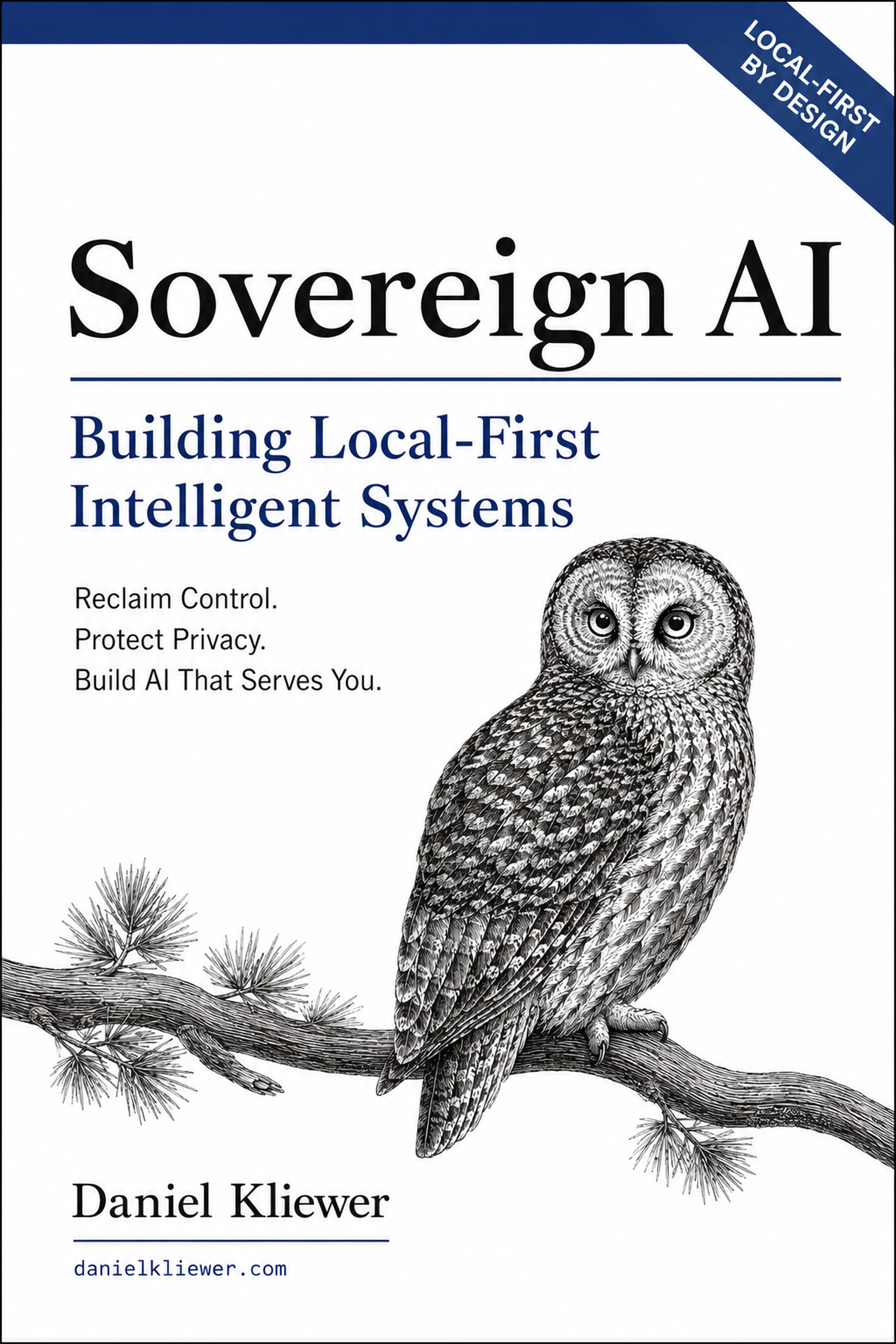
Sovereign AI: An Architectural Investigation into Local-First Intelligence
by Daniel Kliewer · Paperback · 72 pages
An examination of the architecture of intelligence that you own — from first principles through production deployment.